On this page
Ravago
Product Designer
Responsibilities
Feature Design, Design Systems, Research & Discovery
Research that Redirected the Redesign
10
Interviews
10 hours of primary research
3
User personas
identified and validated
3
UI elements
removed
4
Key takeaways
presented
Overview
Ravago is a global leader in plastics distribution. The digital platform serves as a product catalog for business customers sourcing raw plastic materials.
A new feature was on the table: small-lot orders with direct fixed pricing. For the first time, the platform would have access to pricing, lead time, and availability data. Previously, these lived entirely in the quote-request flow. The team had already moved into solution space with information-dense card layouts. I paused the process and asked: who are we designing for?
The assumption was engineers. It hadn't been validated. Analytics tools like Clarity showed user behavior but not user identity or decision criteria. Without knowing the actual audience, any design decision was a guess.
Research
Indirect Discovery
Direct access to platform users was not possible. The platform was new, usage was limited, and customers had no relationship with the platform team. Their touchpoint was the sales organization.
Instead of interviewing customers directly, I conducted 10 one-hour interviews with sellers, the people who speak with customers daily. The critical reframe: rather than asking sellers what they wanted from the platform, I focused on understanding what customers were requesting from them.
Key Findings
The research revealed a clear user hierarchy, and it wasn't what anyone expected.
Primary: The Purchaser
Most frequent catalog visitor. Price-driven decision maker who functions as an internal relay. Typically high urgency.
Secondary: The Multi-Hat
Typical at smaller companies. One person fulfilling multiple roles. Combines price sensitivity with technical interest.
Tertiary: Engineer / R&D
Validates technical feasibility after the Purchaser has done initial sourcing. Needs detailed specs and TDS.
Engineers were not the primary users. Purchasers were. This invalidated the original design direction entirely.
The research also mapped three customer journeys (new product sourcing, product validation, alternative search) and uncovered the real Purchaser-to-Engineer workflow: Purchasers filter → add up to 5 products to a comparison page → share with the Engineer for verification. This meant the card didn't need to display specific feature values at all. All products shown after filtering already meet the applied criteria.
Analysis
What to Remove
The existing card was filled with noise that served neither Purchasers nor Engineers. Idea floated around like dynamically display the feature values matching the active filters on each card. This would create visual chaos across the grid, as cards would show inconsistent content depending on filter state, with additional multi-language maintenance issues. In this case, as a designer was job was to subtract not to add.
Highlighting what doesn't work
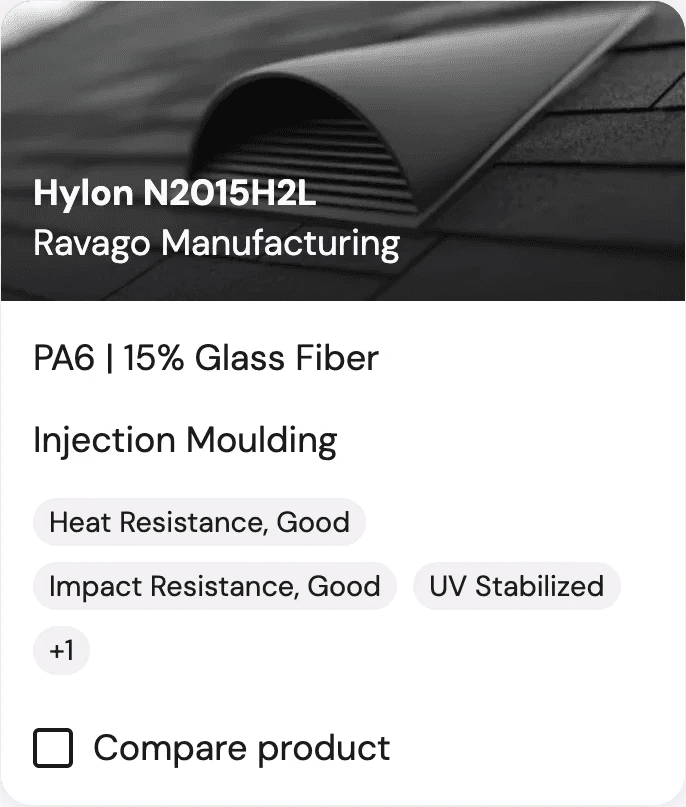
Product Images
Vague Feature Labels
Not always informative
This resulted in the following idea:
Product Images: Granulate & background photos not distinct and informative enough across products. Zero informative value and real visual differentiation.
Remove
Vague Feature Labels: "Impact Resistance Good" is non-quantifiable. With the amount of features, the chance of showing the right one is near zero.
Remove
Filter Hierarchy: "Brand" and "Filler" aren't primary search criteria for Purchasers in discovery mode.
Deprioritize
What to Design For
With the small-lot feature, three critical data points were becoming available for the first time. The research confirmed their importance and defined how they should be presented:
Price.
Primary decision driver. The design challenge: display it for small lots without undermining volume negotiations. Balance transparency with commercial flexibility.
Lead Time.
Extreme urgency among Purchasers. "1 week" is acceptable; "30 weeks" eliminates a product instantly.
Availability.
"Is this in stock? When is restock?" Designing for availability transparency directly impacts conversion.
An unexpected finding: the Recycled label caused negative sentiment. Customers expected recycled material to be cheaper. When quotes came back higher, it created friction. The recommendation: treat sustainability as a specification, not a selling point.
Design Decisions
The research surfaced a strategic direction: the platform should function as a "Digital Seller", not a fully autonomous marketplace. The personal expertise of sellers is a crucial differentiator. The goal: automate low-value tasks while preserving that relationship.
The redesigned card strips away noise and surfaces what actually drives decisions:
Price
"Starting From" price for small lots with a negotiation pathway for larger volumes.
Lead Time
Accurate delivery timeframe, surfacing Ravago's competitive advantage.
Availability
Stock status with restock dates.
Additional MVP elements: MOQ display (a competitive advantage), clear CTA for volume pricing, and removal of all vague feature labels and undifferentiated product images.
Impact
Outcomes
Eliminated the primary friction point in product discovery by designing for price, lead time, and availability
Surfaced one of Ravago's competitive edges (fast delivery) in the digital storefront, previously invisible to customers
Aligned card design with actual user mental models, transaction-first for Purchasers, not feature-first for Engineers
Established a validated user hierarchy (Purchaser → Multi-Hat → Engineer) that informs all future platform decisions
"Digital Seller" positioning adopted as the guiding vision for platform development
The research also surfaced a strategic roadmap beyond the card: ultra-shareable PDPs for one-click Purchaser-to-Engineer sharing, a digital sample follow-up system to prevent leads from dying post-RFS, and price nudging mechanisms to accelerate conversion.
Reflection
Challenge assumptions before designing. The team was building for engineers. The users were Purchasers. Without the research, the redesign would have optimized for the wrong audience.
Indirect research can be just as revealing than direct. By interviewing sellers about customer conversations, not platform preferences, we uncovered key decision drivers.
Executive Summary
Ravago's B2B digital platform introduced a new small-lot ordering feature that required surfacing fixed pricing on product cards, a first for the platform. The team had initial designs ready, but I identified a critical gap: we didn't know who we were designing for. The assumption was engineers. That assumption was wrong.
I led 10 one-hour seller interviews using an indirect discovery method that revealed Purchasers, not engineers, were the primary users. With the small-lot feature, price, lead time, and availability data would become available for the first time. The question wasn't whether to show them. It was how to restructure the entire card around them, what noise to strip away, and how to handle the tension between list pricing and negotiated pricing.
The research informed a redesign that cleared the card of visual clutter and reshaped it into a transaction-focused tool. It also surfaced a broader strategic direction: the platform should function as a "Digital Seller", automating low-value tasks while preserving the personal expertise customers value.
Author's note
This case study covers one facet of my work at Ravago. The product catalog redesign sits within a broader scope of enterprise B2B platform design, research operations, and cross-functional collaboration. Additional case studies covering other projects and domains will follow in the future.